
Every business wants more customers, stronger brand recognition, and steady revenue. The real question is how to get there. Some businesses invest in television ads, billboards, print campaigns, and public relations. Others test landing pages, study customer behavior, improve email campaigns, and track every step of the buying process.
Both approaches can help a business grow, but they work in different ways.
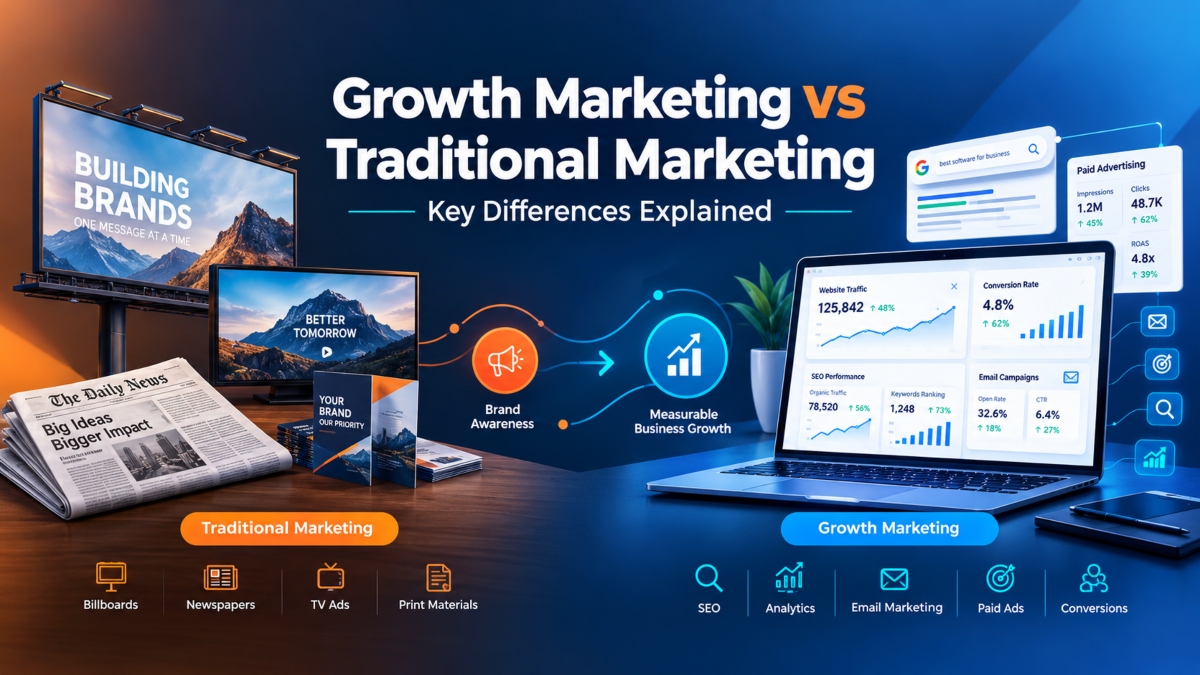
The main difference between growth marketing vs traditional marketing is their focus. Traditional marketing often concentrates on building brand awareness and reaching a broad audience. Growth marketing focuses on improving measurable results throughout the customer journey, from attracting new visitors to turning them into loyal customers.
Neither approach is right for every situation. A new business may need more people to recognize its name, while an established online store may need to turn more visitors into paying customers. Understanding how these strategies work can help you spend your marketing budget wisely and make better decisions for your business.
What Is Traditional Marketing?
Traditional marketing is a campaign based approach that helps businesses introduce their products or services to a target audience. It often focuses on brand awareness, market positioning, and creating interest in what a company offers.
Think about seeing a billboard for a new restaurant while driving home. You might not visit that day, but the name stays in your mind. A few days later, when you need somewhere to eat, you may remember the restaurant and give it a try.
That is one way traditional marketing works. It puts a brand in front of people and gives them a reason to remember it.
Common Traditional Marketing Channels
Traditional marketing uses several channels to reach customers, including:
- Television and radio advertising: Businesses use broadcast ads to reach large audiences.
- Print advertising: Newspapers, magazines, brochures, and flyers help brands share offers and product information.
- Outdoor advertising: Billboards, posters, and transit ads attract attention in public places.
- Direct mail: Businesses send promotional letters, catalogs, and offers to selected households or customers.
- Events and trade shows: Companies meet potential buyers, demonstrate products, and build professional relationships.
- Public relations: Media coverage, press releases, and brand announcements help businesses build recognition and trust.
Traditional marketing can also include digital advertising and social media campaigns. The defining feature is not simply the channel. It is often the way campaigns are planned, delivered, and measured.
Main Goals of Traditional Marketing
The main goal is to make a brand more familiar to its intended audience. Businesses may use traditional marketing to introduce a new product, promote a seasonal offer, enter a new market, or strengthen their public image.
Other common goals include generating leads, increasing store visits, promoting events, and supporting sales.
For example, a local clothing store might run newspaper ads before a holiday sale. The campaign could encourage people to visit the store during a specific weekend. Its performance might be judged by customer visits, sales figures, coupon use, and the number of people who remember the promotion.
How Traditional Marketing Measures Success
Traditional marketing often uses metrics such as:
- Reach and impressions
- Brand awareness and recall
- Customer engagement
- Website traffic
- Leads generated
- Cost per lead
- Sales and campaign return on investment
Some results are easy to measure, while others require customer surveys, unique promotional codes, sales comparisons, or other tracking methods.
A billboard may reach thousands of people, for example, but it can be difficult to determine exactly how many made a purchase because of it. That does not mean the billboard has no value. It means the business needs to choose suitable ways to assess its results.
What Is Growth Marketing?
Growth marketing is a data driven approach that uses testing, customer research, and ongoing improvements to help a business achieve better results.
Instead of focusing only on how many people see an advertisement, growth marketers ask what happens next. Do visitors sign up? Do leads become customers? Do customers return? Do they recommend the business to others?
These questions help teams find areas where marketing can work better.
Growth marketing brings several activities together, including search engine optimization, content marketing, paid advertising, email marketing, landing page testing, and customer retention campaigns. Each activity supports a wider plan to attract, convert, and keep customers.
Core Elements of Growth Marketing
Customer research
Growth teams study customer needs, buying habits, common questions, and reasons people leave without purchasing. This helps them create offers and messages that fit the audience.
Experimentation
Rather than assuming one message will work best, marketers test different headlines, calls to action, offers, and page layouts. They then compare the results.
Conversion rate optimization
Conversion rate optimization, often called CRO, focuses on helping more visitors take a desired action. That action might be booking a demo, completing a purchase, signing up for a newsletter, or requesting a quote.
Email marketing and automation
Email campaigns can guide new leads toward a purchase, welcome new customers, encourage repeat orders, and remind inactive users about a product or service.
Customer retention
Growth marketing does not stop once a sale is complete. It also looks at how businesses can keep customers satisfied, encourage repeat purchases, and reduce cancellations.
How the Growth Marketing Process Works
Growth marketing usually follows a repeatable process.
- Find an opportunity. Identify a problem, such as a high cart abandonment rate or a low number of demo bookings.
- Create a hypothesis. Suggest a change that might improve the result.
- Run a test. Compare the new approach with the existing one when suitable.
- Measure the outcome. Review the data to see whether the change helped.
- Make a decision. Keep the change if the evidence supports it, revise it if the results are unclear, or stop it if it performs poorly.
- Repeat the process. Use what you learn to identify the next opportunity.
For example, an online store may notice that many visitors add products to their carts but leave before paying. The team could test a simpler checkout page or display delivery costs earlier. If the change improves completed orders without creating other problems, the store can keep refining the buying experience.
The goal is not to run endless tests for the sake of testing. It is to find practical changes that help the business serve customers better and produce stronger results.
Growth Marketing vs Traditional Marketing: Key Differences
Both approaches aim to help businesses reach customers, but their methods, priorities, and measures of success can differ.
| Factor | Traditional Marketing | Growth Marketing |
|---|---|---|
| Main focus | Brand awareness and demand | Measurable business growth |
| Planning | Often campaign based | Ongoing testing and improvement |
| Decision making | Creative strategy and market research | Customer data, experiments, and results |
| Customer journey | Often focuses on awareness and interest | Covers acquisition, conversion, retention, and referrals |
| Channels | TV, radio, print, outdoor ads, events, and PR | SEO, email, paid media, CRO, content, and lifecycle campaigns |
| Common metrics | Reach, impressions, brand recall, and leads | Conversion rate, CAC, retention, LTV, and revenue |
| Time frame | Often tied to campaign dates | Continuous improvement over time |
| Budget decisions | Planned around campaign needs | Adjusted using performance data and business goals |
| Main strength | Broad exposure and brand recognition | Finding ways to improve customer and business results |
| Main limitation | Some results are hard to attribute | Requires suitable data, testing, and skilled staff |
Differences in Goals and Planning
Traditional marketing often starts with a campaign goal. A business may want to introduce a new service, increase brand recognition, or promote a seasonal offer.
Growth marketing starts with a business outcome or a problem in the customer journey. A team might want to increase qualified leads, improve trial signups, reduce customer churn, or increase the number of repeat purchases.
The planning process reflects these goals. Traditional campaigns may have a defined budget, launch date, and end date. Growth marketing usually works through ongoing cycles of research, testing, and improvement.
However, traditional marketing can also use performance data, and growth marketing campaigns can have fixed deadlines. The difference is the level of focus placed on continuous testing and full customer journey results.
Differences in Channels and Execution
Traditional marketing is closely associated with offline channels such as television, radio, print, and outdoor advertising. These channels can be useful when a business needs broad exposure or wants to reach people in a specific location.
Growth marketing often connects digital channels such as SEO, paid search, email, content marketing, and website optimization. The aim is to understand how these activities work together rather than judging each one in isolation.
For example, a company might use paid advertising to attract visitors, SEO content to answer their questions, and email marketing to help interested leads make a decision.
A traditional campaign can still be part of this process. The two approaches are not defined by a strict division between offline and online marketing.
Differences in Measurement and Budget
Traditional marketing may place greater emphasis on campaign reach, brand recall, and lead volume. Growth marketing puts more attention on how marketing activity affects conversion, customer acquisition costs, retention, and revenue.
Consider two businesses spending the same amount on marketing. One generates thousands of website visits but few sales. The other attracts fewer visitors but converts a larger share into paying customers.
Traffic alone would not tell the full story. Comparing conversion rates, acquisition costs, and customer value would give both businesses a clearer picture of their performance.
That is why growth marketing uses measurement to guide decisions about where to spend, what to change, and which activities deserve further investment.
How Growth Marketing and Traditional Marketing Differ Across the Customer Journey
The customer journey helps explain why these approaches can work well together.
Traditional marketing often places a strong emphasis on the early stages, when people first discover a brand. Growth marketing also works at this stage, but it continues through the steps that turn interest into lasting customer relationships.
Awareness and Customer Acquisition
At the awareness stage, a business wants its target audience to discover its products or services.
A billboard, radio advertisement, trade show, or public relations campaign can help introduce a brand to people who have never heard of it. Growth marketing can support this goal through SEO, paid search, content marketing, and tests that help attract more relevant visitors.
The key is to attract people who are likely to benefit from the offer, not simply to reach the largest possible audience.
Conversion and Activation
Getting attention is only the first step. The next challenge is helping interested people take action.
A visitor might read a service page but leave without requesting a quote. A software user might create an account but never complete the setup process. These are different problems, and each needs a suitable response.
Growth marketers can test landing page copy, simplify forms, improve product onboarding, or adjust the timing of follow up emails. Small changes may improve results, although the outcome should be measured rather than assumed.
Retention, Referrals, and Revenue
A customer who buys once may return, recommend the business, or choose a competitor next time. The experience after the sale matters.
Growth marketing can help businesses encourage repeat purchases through helpful email campaigns, loyalty offers, product recommendations, and customer support improvements.
For subscription businesses, retention work may focus on helping customers use the product, understand its value, and find solutions before they decide to cancel.
Traditional marketing can support these efforts through customer events, brand campaigns, and loyalty promotions. The best approach depends on the audience and the business model.
Metrics That Matter in Growth Marketing and Traditional Marketing
Marketing metrics help businesses understand whether their activities are producing the results they want. The right measures depend on the campaign goal, customer journey, and type of business.
Traditional Marketing Metrics
Reach and impressions: Reach estimates how many people saw a campaign, while impressions count the total number of times an ad was displayed.
Brand awareness and recall: These measures help businesses understand whether people recognize or remember a brand.
Engagement: Responses, interactions, event attendance, and other actions can show how people react to a campaign.
Leads generated: This measures how many potential customers express interest through enquiries, calls, signups, or other actions.
Cost per lead: This shows how much a business spends to generate each lead.
Campaign return on investment: ROI compares the financial return from a campaign with its costs, although accurate measurement depends on reliable sales and attribution data.
Growth Marketing Metrics
Conversion rate: The percentage of people who complete a desired action, such as purchasing a product or booking a demo.
Customer acquisition cost (CAC): The cost of acquiring a customer. Businesses should define which sales and marketing expenses they include when calculating it.
Activation rate: The share of new users who complete an action that signals they are beginning to receive value from a product or service.
Retention rate and churn: Retention measures how many customers continue using a product or service over a defined period. Churn measures the share who leave during that period.
Customer lifetime value (LTV): An estimate of the value a customer brings over the course of the relationship.
LTV to CAC ratio: A comparison between customer lifetime value and acquisition cost. It can help businesses assess whether their acquisition model makes financial sense.
Revenue and referral rate: These measures help teams track sales outcomes and how often customers recommend the business to others.
The important point is that neither approach has exclusive ownership of these metrics. Traditional marketers can measure revenue, and growth marketers can measure awareness. Growth marketing simply places more emphasis on using data to improve results across the full customer journey.
Benefits and Limitations of Each Approach
Neither marketing approach guarantees success. Each has strengths, and each comes with tradeoffs.
Benefits and Limitations of Traditional Marketing
Traditional marketing can help a business reach a broad audience, build familiarity, and create a recognizable public image. It is useful for local promotions, major product launches, events, and brands that benefit from a physical presence.
A well placed billboard or a strong radio campaign can introduce a business to people who may not be actively searching for it online.
However, some traditional channels require substantial upfront spending. It can also be difficult to determine which people purchased because of a particular advertisement. Results may take time to assess, especially when the goal is to build brand awareness rather than generate immediate sales.
Businesses can reduce these problems by setting clear goals, tracking campaign codes where possible, and comparing results before and after a campaign.
Benefits and Limitations of Growth Marketing
Growth marketing gives teams a structured way to test ideas, learn from customer behavior, and improve marketing performance. It can help businesses find weak points in their sales process and use their budgets more carefully.
For example, a small improvement in checkout completion may increase sales without requiring the business to attract a large number of additional visitors.
The approach still has limitations. Teams need reliable tracking, enough data to assess results, and the skills to design useful experiments. Tests based on very small samples can produce misleading conclusions. Poorly tracked data can also lead to bad decisions.
Growth marketing is not a shortcut to instant results. It works best when teams set clear goals, test sensible ideas, and give changes enough time to produce useful evidence.
When Should a Business Use Traditional Marketing?
Traditional marketing can be a good choice when a business needs broader recognition, wants to reach people in a specific area, or has a campaign that depends on physical visibility.
Best Use Cases for Traditional Marketing
Product launches: A company introducing a new product may use print ads, outdoor advertising, public relations, or events to build awareness before launch day.
Local businesses: Restaurants, retail shops, gyms, and service providers can use local newspapers, flyers, outdoor signs, and community events to reach nearby customers.
Established brands: Businesses with broad audiences may use television, radio, or large outdoor campaigns to reinforce brand recognition.
Events and trade shows: Companies selling products or services to professional buyers may benefit from demonstrations and face to face conversations.
Trust focused campaigns: Some businesses benefit from a visible local presence, customer events, and consistent brand messaging.
Imagine a new fitness center opening in a busy neighborhood. Online ads may help people find its website, but outdoor signs, local promotions, and community events can also help residents notice the new location. A combination of channels may reach people who would otherwise miss the launch.
When Should a Business Use Growth Marketing?
Growth marketing is especially useful when a business can track customer actions and wants to improve how it attracts, converts, or retains customers.
Best Use Cases for Growth Marketing
Startups: New companies can test messages, offers, and acquisition channels to learn which customers respond best.
SaaS companies: Software businesses can measure trial signups, product activation, demo bookings, upgrades, and cancellations.
eCommerce stores: Online retailers can test product pages, checkout steps, email campaigns, and repeat purchase offers.
Subscription businesses: These companies can study churn, onboarding, product usage, and renewal behavior.
Businesses with measurable sales funnels: Companies that track website visits, enquiries, sales, and customer activity can use that data to find areas for improvement.
For example, a SaaS company may attract plenty of free trial users but struggle to turn them into paying customers. A growth marketing team could review the signup process, ask users where they get stuck, and test changes to onboarding emails or product guidance.
The aim is to find out what helps users experience the product’s value and become paying customers. The results can guide future decisions about both acquisition and retention.
Can Growth Marketing and Traditional Marketing Work Together?
Yes. In many cases, combining both approaches gives a business more options than relying on either one alone.
Traditional marketing can help people discover and remember a brand. Growth marketing can help the business understand what those people do next and where improvements may increase sales or customer retention.
Build Awareness Through Traditional Channels
Businesses can use outdoor advertising, events, public relations, print campaigns, and other suitable channels to introduce their brand to a target audience.
The choice should reflect where customers spend their time and how they prefer to learn about products or services.
Improve Results Through Growth Marketing
Once people show interest, businesses can use SEO content, landing pages, email campaigns, analytics, and conversion testing to help turn that interest into action.
For example, a company might run an event to introduce a new service, then direct interested visitors to a landing page where they can book a consultation. The marketing team can track enquiries, test the page copy, and review how many bookings become paying customers.
Example of a Combined Marketing Strategy
Consider a B2B SaaS company selling project management software.
The company could use industry events, public relations, and brand campaigns to build recognition among business decision makers. At the same time, it could publish SEO content to attract people searching for project management solutions.
Visitors could then reach a page offering a product demo. The team could test the page headline, shorten the booking form, and send useful follow up emails to interested leads. After customers sign up, onboarding campaigns could help them learn the product and remain active.
Each activity has a purpose. Brand marketing helps the company reach new audiences, while growth marketing helps improve the steps between discovery, purchase, and continued use.
The result is a connected marketing plan in which awareness and customer experience support the same business goals.
How to Choose the Right Marketing Approach for Your Business
The best choice starts with a clear understanding of your current business problem. Before spending money on a new campaign, work out what needs to change.
1. Define Your Main Business Goal
Do you need more people to recognize your brand? Are you struggling to generate qualified leads? Do visitors reach your website but leave without purchasing? Are existing customers leaving too soon?
Each problem calls for a different response.
If awareness is low, brand campaigns and targeted outreach may help. If you already attract relevant visitors but struggle to convert them, improving the website or sales process may be a better starting point.
2. Review Your Budget, Team, and Data
Traditional campaigns can require substantial spending on media, production, events, and creative work. Growth marketing may require analytics tools, technical support, skilled staff, and time to run tests.
Neither approach is automatically cheaper. The cost depends on the channels, campaign goals, business model, and resources available.
Review what your team can manage and how you will measure results before committing to a plan.
3. Start With Your Biggest Business Bottleneck
Look at the customer journey and find the stage where progress slows down.
If too few people know about your business, work on awareness. If website traffic is healthy but enquiries are low, review your landing pages, offer, and calls to action. If customers buy once but never return, examine the post purchase experience and retention strategy.
Start with one clear problem, set a measurable goal, and review the results before expanding the plan.
For many businesses, the best option is a combination of traditional marketing and growth marketing. Use the methods that fit your audience, budget, and immediate goals, then adjust the strategy as you learn more about your customers.
Frequently Asked Questions
What Is the Main Difference Between Growth Marketing and Traditional Marketing?
Traditional marketing often focuses on brand awareness, audience reach, and demand creation through planned campaigns. Growth marketing uses data, experiments, and ongoing improvements to increase acquisition, conversion, retention, referrals, and revenue. Both can support sales, but growth marketing places greater emphasis on improving the full customer journey.
Is Growth Marketing Better Than Traditional Marketing?
Neither approach is always better. Growth marketing can suit businesses that need to improve measurable results across their customer journey. Traditional marketing can be useful when broad awareness, local visibility, or brand recognition is the main goal. The right choice depends on the business, audience, budget, and marketing objectives.
Is Growth Marketing the Same as Digital Marketing?
No. Digital marketing refers to marketing activities carried out through online channels, such as search engines, websites, email, and social media. Growth marketing is an approach to improving business results through testing and measurement. It often uses digital channels, but it can also include offline campaigns and other customer touchpoints.
What Are the Best Examples of Growth Marketing?
Common examples include testing landing page headlines, improving checkout processes, sending onboarding emails, creating referral programs, refining SEO content, and improving customer retention campaigns. The best test depends on the business problem. An online store may focus on completed purchases, while a software company may work on trial activation or paid subscriptions.
Which Marketing Approach Is Best for Startups?
Growth marketing can help startups test customer demand, identify suitable acquisition channels, and use limited budgets carefully. However, some startups also need traditional marketing to introduce their brand to a broader audience. A startup should begin with its most urgent business goal and choose methods it can track and manage.
Can a Business Use Both Marketing Approaches?
Yes. A business can use traditional marketing to build brand awareness and growth marketing to improve conversions, customer retention, and revenue. For example, a company might promote its brand at an industry event, then use a landing page, email follow ups, and sales data to turn interested visitors into customers.
How Do You Measure Growth Marketing Success?
Growth marketing success depends on the business goal. Common measures include conversion rate, customer acquisition cost, activation rate, customer retention, churn, customer lifetime value, revenue, and referrals. Teams should choose metrics that reflect meaningful business outcomes and use reliable data to assess whether their experiments produce better results.
Final Thoughts
Growth marketing vs traditional marketing is not a contest with one winner. Each approach serves a different purpose, and both can help a business reach its goals.
Traditional marketing can introduce your brand to new audiences, build recognition, and create interest in your products or services. Growth marketing helps you understand what happens after that first interaction and find ways to improve conversions, customer retention, and revenue.
Start by identifying the biggest challenge facing your business. If people do not know your brand, focus on reaching the right audience. If you already attract visitors but struggle to turn them into customers, look for ways to improve the customer journey.
When both awareness and measurable growth matter, combine the two approaches in a clear marketing plan. Track your results, learn from customer behavior, and keep improving the parts of your strategy that matter most to your business.