
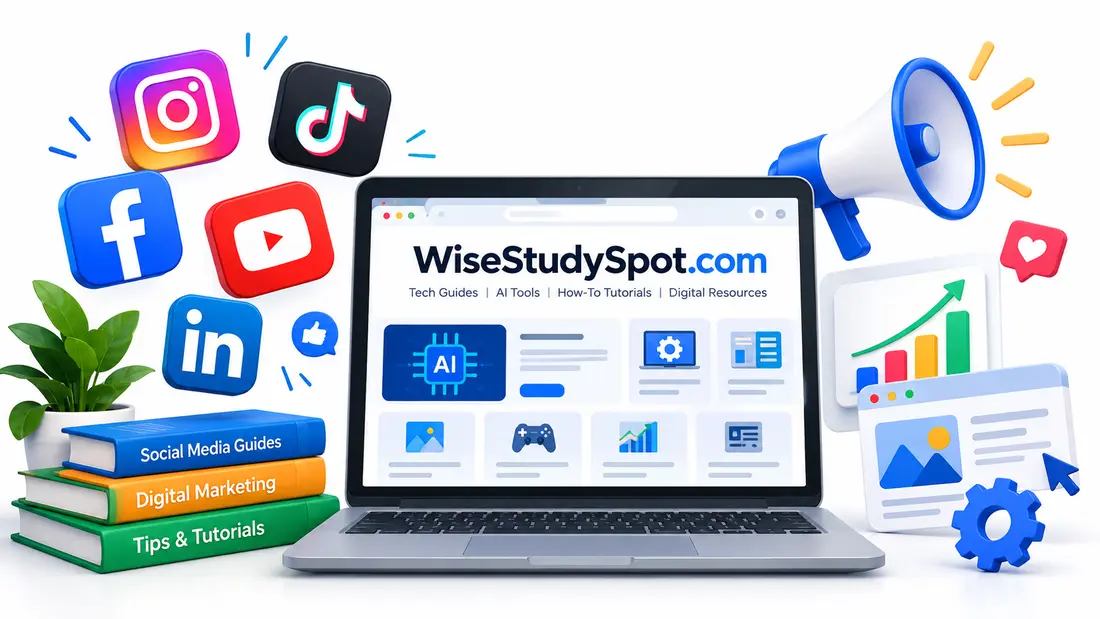
When people search for social media wisestudyspot.com, they may be looking for social media tips, technology guides, or digital marketing information connected with WiseStudySpot.com. The phrase can be a little confusing at first, especially if you expect to find one specific social media page.
WiseStudySpot.com presents itself as a technology and digital learning website. Its content areas include artificial intelligence, software tools, technology news, gadget reviews, and practical how-to guides.
But what does the search phrase actually mean? Can beginners use the website to learn about social media? And how can you tell whether an online guide is accurate and safe to follow?
This article answers these questions and explains how to find useful digital resources, check online information, and make better use of social media for personal or business goals.
What Is Social Media WiseStudySpot.com?
The phrase social media wisestudyspot.com combines two things: social media and the website name WiseStudySpot.com.
Social media refers to online platforms where people share content, communicate, build communities, and promote products or services. Instagram, Facebook, TikTok, YouTube, and LinkedIn are common examples.
WiseStudySpot.com, on the other hand, is presented as a website covering technology, AI, software, and digital learning resources.
People searching for this phrase may want to find beginner-friendly social media advice, learn about digital tools, or understand how online platforms work. Others may simply be trying to identify the website associated with the search term.
It is worth making one distinction clear: the search phrase does not automatically refer to a dedicated social media page or a specific tutorial. Readers should check the website’s current articles to confirm which topics are available.
What Does WiseStudySpot.com Offer?
Technology changes quickly. New apps appear, software receives updates, and familiar tools gain new features. Websites that publish practical technology guides can help readers understand these changes without needing an advanced technical background.
WiseStudySpot.com describes itself as a resource for technology-related information. Its stated areas of interest include several topics.
AI and Digital Resources
Artificial intelligence tools have become part of many everyday online tasks. Writers use them to plan articles, creators use them to develop video ideas, and businesses use them to support customer service and marketing.
AI-related resources can help readers understand how these tools work, what they can do, and where their limits lie.
For example, a blogger might use an AI writing assistant to develop an article outline before adding personal knowledge and checking the facts. A video creator might explore AI tools to speed up editing or create a first draft of a script.
The key is to treat AI as a tool rather than a replacement for human judgment. Generated information still needs to be checked before publication or use.
Software and Online Tools
Software guides can help people choose tools for work, study, content creation, and website management.
These resources may cover topics such as:
- Software for productivity and project management
- Browser extensions and online utilities
- SaaS products for businesses
- Tools for website owners and content creators
- Applications that support digital marketing tasks
Imagine running a small business and managing your own social media accounts. You might need one tool to schedule posts, another to create graphics, and a simple spreadsheet to record results.
Learning what each tool does can save time and help you avoid paying for features you do not need.
Technology News and Gadget Reviews
Technology news helps readers keep up with changes in software, online services, digital privacy, and consumer devices.
Gadget reviews serve a different purpose. They help buyers understand a product’s features, strengths, limitations, and suitability for their needs.
When reading a review, look beyond a product’s promotional claims. Battery life, build quality, compatibility, warranty coverage, and price can matter more than a long list of technical specifications.
The same principle applies to software. A tool may have impressive features but still be a poor choice if it is difficult to use or does not fit your workflow.
How-To Guides
How-to articles explain how to complete a task one step at a time. They can be especially useful for beginners who want to solve a problem without spending hours searching through technical documentation.
Examples of common technology tutorial topics include:
- Setting up and managing a WordPress website
- Performing a basic SEO audit
- Using software to organize work
- Understanding website performance
- Learning new digital publishing methods
Before relying on a particular tutorial, check whether the article is available on the website and whether its instructions match the latest version of the relevant tool.
What Social Media Topics Might Readers Be Looking For?
Someone searching for social media information associated with WiseStudySpot.com may be interested in several platforms. Each one serves a different purpose, so the right approach depends on what you want to achieve.
Instagram Tips for Beginners
Instagram gives individuals, creators, and businesses a place to share photos, videos, Stories, and Reels.
New users may want to learn how to:
- Set up a clear and useful profile
- Create Reels that hold viewers’ attention
- Write captions that explain the value of a post
- Use relevant hashtags without overloading captions
- Manage privacy and account settings
- Review available creator and analytics features
A common mistake is to focus entirely on follower numbers. A smaller audience that regularly watches, comments on, or shares your content may be more useful than a larger audience that rarely interacts.
Start by choosing a clear topic for your account. Publish content that serves that topic, then review which posts attract meaningful responses.
Facebook Pages and Groups
Facebook remains useful for community discussions, local businesses, customer communication, and interest-based groups.
A business owner might use a Page to share opening hours, product updates, customer feedback, and special offers. A Group may be more suitable for discussions among people with a shared interest.
Beginners can start by learning how to:
- Create and manage a business Page
- Publish useful updates
- Respond to comments and messages
- Manage Group settings and member activity
- Review privacy options
- Understand the basics of Facebook advertising
Before running an advertisement, decide what action you want people to take. You might want them to visit your website, send an inquiry, or purchase a product. A clear goal makes it easier to judge whether the campaign is worth the cost.
TikTok Content Creation
TikTok is built around short-form video discovery. Creators can use it to share tutorials, entertainment, product demonstrations, stories, and practical advice.
If you are new to TikTok, begin with a simple video idea. You do not need an expensive camera or a complicated editing setup to communicate something useful.
Try this basic process:
- Open with a question, problem, or interesting statement.
- Explain one main idea rather than several unrelated points.
- Use clear visuals and readable text where appropriate.
- Keep the pacing suitable for the topic.
- Review the available analytics after publishing.
For example, a creator making technology videos could demonstrate one useful phone setting in less than a minute. A clear demonstration may be more useful to viewers than a long introduction.
Trends and sounds can help a video fit a current format, but they do not guarantee views. Original ideas, clear delivery, and audience interest still matter.
YouTube Channel Growth
YouTube supports long-form videos, Shorts, tutorials, reviews, and educational content.
A beginner planning a channel should pay attention to a few basics:
- Choose a clear subject for the channel.
- Write titles that accurately describe each video.
- Create thumbnails that are easy to understand at a glance.
- Organize related videos into playlists.
- Use analytics to understand viewer behavior.
- Improve future videos based on audience feedback.
Suppose you publish a tutorial about fixing a common software problem. A direct title and a thumbnail showing the relevant tool may help viewers understand what they will learn before clicking.
Once the video is live, look at viewer retention and other available analytics. If many people leave during the introduction, try getting to the main point sooner in your next video.
LinkedIn for Professional Networking
LinkedIn focuses on professional identity, business communication, networking, and career-related content.
Students can use it to present their skills and projects. Freelancers can share examples of their work. Business owners can publish useful updates and connect with people in their industries.
A useful starting point is to complete your profile with a clear description of your skills, experience, and current goals.
When posting, focus on information that helps your intended audience. A practical lesson from a project, a short industry observation, or an explanation of a common problem can give people a reason to engage with your content.
Avoid treating every connection as a sales opportunity. Professional relationships often grow through useful conversations and consistent communication.
Social Media Marketing Strategies
Social media marketing involves more than publishing posts. It requires a clear audience, useful content, regular activity, and a way to measure results.
A basic strategy includes the following steps.
1. Define your audience. Understand who you want to reach and what information, products, or services they need.
2. Choose suitable platforms. A visual product may benefit from Instagram or TikTok, while professional services may fit LinkedIn better.
3. Plan your content. Create a simple calendar that balances educational posts, demonstrations, stories, and relevant promotional content.
4. Set a realistic schedule. Choose a publishing frequency you can maintain without sacrificing quality.
5. Measure performance. Track relevant metrics such as reach, watch time, comments, website visits, leads, and sales.
6. Adjust your approach. Keep testing ideas and use the results to guide future content.
You do not need to be active on every social platform. It is usually better to manage a few suitable channels well than to publish weak content everywhere.
Is WiseStudySpot.com a Social Media Learning Platform?
WiseStudySpot.com is best described according to the features it publicly presents and the content available on its live website. Its stated focus is technology and digital resources, rather than a confirmed structured social media training program.
There is an important difference between an informational blog and a formal learning platform.
An informational blog usually publishes individual articles that explain topics or help readers complete specific tasks. A structured learning platform may offer lessons arranged into courses, assignments, assessments, instructor support, or certificates.
Here is how the two models compare.
| Feature | Informational blog | Structured learning platform |
|---|---|---|
| Individual articles and guides | Common | May be available |
| Lessons arranged into courses | Not required | Common |
| Quizzes and assessments | Not required | May be available |
| Instructor support | Not required | May be available |
| Certificates | Not usually expected | Depends on the provider |
| Main purpose | Quick answers and topic learning | Organized learning and skill development |
This distinction matters because a website with words such as “study” or “learning” in its name does not necessarily offer formal courses or certificates.
If you want to learn a specific skill, check the available content before committing your time or money. For professional training, look for a course with a clear syllabus, practical exercises, qualified instruction, and transparent details about any certificate offered.
Is WiseStudySpot.com Legit and Safe to Use?
It is sensible to check a website before trusting its advice, downloading files, or sharing personal information.
However, legitimacy and safety are not exactly the same thing. A website may publish genuine informational content without being an accredited educational provider. Likewise, a professional-looking website is not automatically trustworthy.
The following checks can help you make a more informed decision.
Check the Website Address
Pay attention to the spelling of the domain. The website discussed in this article is wisestudyspot.com.
Look carefully for misspellings, extra words, unexpected subdomains, or addresses that imitate a familiar name. If you arrive through a search result or social media post, check the address bar before entering any information.
Review the Website’s Information
Look for an About page that explains the website’s purpose. A Contact page can help you understand how to reach the publisher, while a Privacy Policy explains how personal information may be handled.
You can also review article authorship, publication dates, and update dates. These details help you judge whether the information is current and whether the publisher takes responsibility for its content.
The absence of a particular feature does not prove a website is fraudulent, but it may give you a reason to seek more information.
Understand What HTTPS Does
HTTPS helps protect information as it travels between your browser and a website. This is especially important when a page handles login details or other private information.
Still, HTTPS does not prove that a website is honest, that its claims are accurate, or that every download is safe.
Treat it as one security check, not a complete trust assessment.
Be Careful With Downloads and Personal Details
Avoid downloading unfamiliar files just because a page promises a useful tool or social media shortcut.
Be cautious if a website asks for passwords, verification codes, payment details, or other sensitive information without a clear reason. Never share your account password with a third-party service that claims it can deliver instant followers or guaranteed engagement.
If something feels unusual, stop and verify the request before continuing.
How to Verify Social Media Advice Found Online
Social media apps change their interfaces, settings, and policies regularly. A guide that worked last year may no longer match the options available in the current app.
Before following an online tutorial, use this simple process.
Step 1: Check the Publication Date
Look for the original publication date and any update date. Recent information is especially important for account settings, monetization requirements, advertising features, and privacy controls.
A newer article is not automatically correct, but an old guide deserves closer checking when it discusses features that change often.
Step 2: Compare the Instructions With Your App
Open the relevant app and follow the steps carefully. If a menu or setting is missing, do not assume you made a mistake. The interface may have changed, or the feature may not be available for your account.
Check whether the instructions apply to your device, account type, and region.
Step 3: Consult Official Help Resources
When an instruction affects account security, payments, monetization, or privacy, verify it through the platform’s official support resources.
This is particularly useful for recovering an account, changing security settings, appealing a restriction, or understanding current eligibility requirements.
Step 4: Question Promises of Instant Results
Be skeptical of claims that promise guaranteed followers, instant viral videos, or a guaranteed solution to a reach problem.
Social media performance depends on several factors, including content quality, audience interest, platform rules, and how viewers respond. No general tip can guarantee a specific result for every account.
Step 5: Test One Change at a Time
If you want to improve your content, avoid changing everything at once.
Try a different opening, a clearer thumbnail, or a more focused caption. Compare the results with similar posts and give yourself enough information to judge what changed.
This approach helps you learn from your own audience rather than relying on generic advice alone.
Who Can Benefit From WiseStudySpot.com?
The usefulness of any technology website depends on its actual content and how well that content matches the reader’s needs.
Based on the website’s stated focus, several groups may find its digital resources relevant.
Students and Digital Beginners
Students who want to understand software, AI tools, and basic technology concepts may benefit from clear introductory articles.
For example, someone learning how websites work could begin with a basic guide before moving on to more advanced technical material.
Bloggers and Content Creators
Bloggers and creators often need to manage several tasks, including topic research, content planning, editing, publishing, and performance tracking.
Articles about software, AI tools, and SEO can help them learn about different ways to organize this work. They should still check facts independently and avoid publishing generated or copied material without review.
Small Business Owners
Small business owners may need to handle website updates, social media, customer messages, and online promotion with limited time.
A practical guide to a relevant tool can help them complete a task without hiring someone for every small change. The best resources explain both the steps and any limitations the reader should know about.
Beginner Digital Marketers
People starting in digital marketing can use introductory resources to learn about SEO, content publishing, software, and social media.
However, marketing knowledge grows through practice as well as reading. Try applying a technique to a small project, record the results, and use what you learn to improve your next attempt.
How Social Media Supports Website Growth
Social media can help a website reach readers who may never discover it through search alone.
When a business or publisher shares useful content on relevant platforms, people can visit the website, discuss the material, and share it with others.
Here are a few ways social media can support a website.
Content Distribution
A new blog article can be turned into a short social post, a video summary, or a series of practical tips.
For example, a website publishing a guide to AI tools could share three useful points from the article in a short video. Interested viewers may then visit the full article to learn more.
The social post should provide genuine value rather than simply asking people to click.
Audience Engagement
Comments, messages, and discussions can reveal what readers want to know.
If several people ask the same question, that may be a good subject for a future article or tutorial. Listening to these questions can help a publisher create content that answers real needs.
Referral Traffic
Social posts can bring visitors directly to a website. Analytics tools can help publishers identify which platforms and posts send useful traffic.
A large number of social interactions does not always translate into website visits, leads, or sales. Track the results that matter to your goals rather than relying on likes alone.
Community Building
Regularly sharing useful information can help a publisher build a group of returning readers.
Consistency matters, but it should not mean publishing just to fill a calendar. A smaller number of relevant, well-prepared posts may serve an audience better than a constant stream of repetitive updates.
Measuring Results
Use available analytics to review reach, engagement, website visits, conversions, and other relevant metrics.
For example, a small business may find that one platform brings many visitors while another generates more inquiries. That information can help the business decide where to spend its time and budget.
Social media can support website discovery and audience development, but activity on these platforms does not guarantee improved search rankings.
Frequently Asked Questions
What does social media wisestudyspot.com mean?
It is a search phrase that may be used by people looking for social media information, digital marketing advice, or technology resources associated with WiseStudySpot.com. It does not necessarily identify one specific article or social media page.
What is WiseStudySpot.com?
WiseStudySpot.com presents itself as a technology and digital learning website covering topics such as AI, software tools, technology news, gadget reviews, and how-to guides.
Does WiseStudySpot.com offer Instagram and TikTok tutorials?
The availability of specific Instagram or TikTok tutorials should be confirmed by checking the website’s current articles. Do not assume that a particular guide exists based only on the search phrase.
Is WiseStudySpot.com a formal online learning platform?
Its stated focus is on informational technology and digital resources. Readers should check the live website to determine whether it offers structured courses, instructor support, assessments, or certificates.
Is WiseStudySpot.com safe to visit?
Use standard online safety practices. Check the domain spelling, review website information, avoid suspicious downloads, and verify important claims before acting on them. These checks are useful, but they do not replace a full security assessment.
Can beginners use WiseStudySpot.com?
Beginners may find introductory technology and how-to content useful if the available articles match their needs. Readers should choose resources suited to their current skill level and verify instructions that involve changing software or account settings.
Where can I verify social media instructions?
Use the official Help Centers and support resources for the relevant platform. These are particularly important when dealing with account security, privacy, monetization, advertising, or account recovery.
How can I learn social media marketing as a beginner?
Start by choosing one platform and one clear goal. Learn the basic features, publish useful content, review the available analytics, and improve your approach based on the results. Once you understand the basics, you can expand to other platforms or explore more advanced training.
Final Thoughts on Social Media WiseStudySpot.com
The search phrase social media wisestudyspot.com can be understood as a search for social media information associated with WiseStudySpot.com. The website describes its main focus as technology, AI, software, gadget reviews, and practical digital guides.
For readers, the best starting point is to identify the exact information they need, check whether the website has a relevant article, and verify important instructions before following them.
If your goal is to learn social media marketing, begin with the platform you use most. Focus on creating useful content, understanding your audience, and measuring results. If you are exploring technology resources, check the accuracy and freshness of each guide rather than relying on the website name alone.
A careful approach to online learning helps you spend less time following outdated advice and more time building skills you can put to use.
Read Also: ProgramGeeks Hosting: Is It Legitimate and Worth It?