
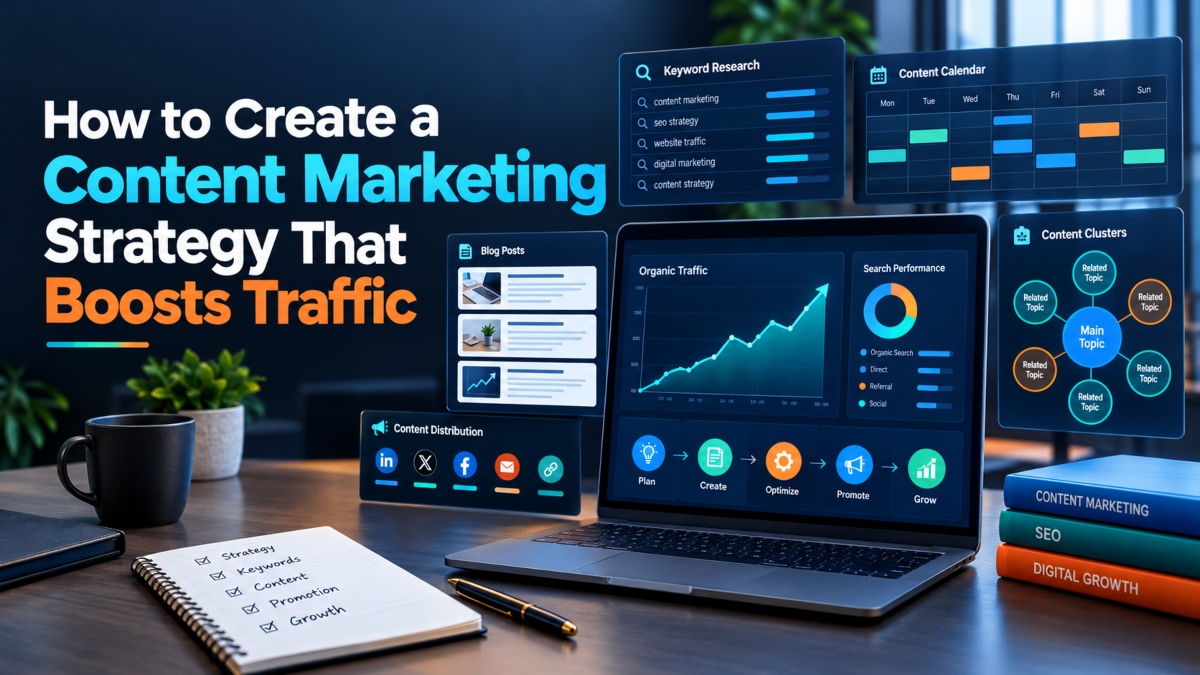
Publishing blog posts every week does not always bring more visitors to your website. You can spend hours researching keywords, writing articles, and sharing them on social media, only to see your traffic stay flat. The problem is often not the amount of content you publish. It is the lack of a clear plan behind it.
A strong content marketing strategy gives every article a purpose. It helps you understand what your audience wants, choose topics people search for, create useful content, and share it through the right channels. It also gives you a way to measure progress and improve your results over time.
Whether you run a small business, manage a SaaS website, or write for a marketing blog, you can use the same basic process to attract more relevant visitors. The key is to connect audience research, keyword planning, content creation, promotion, and performance tracking.
In this guide, you will learn how to build a content marketing strategy that supports steady website traffic and helps turn visitors into potential customers.
1. Define Your Target Audience and Content Marketing Goals
Before writing your next article, ask yourself two simple questions: Who do you want to reach, and what do you want those people to do after reading your content?
Your answers will shape the topics you choose, the keywords you target, and the formats you create. Without this direction, it is easy to publish articles that attract visitors who have little interest in your products or services.
Create Audience Personas Based on Real Customer Needs
An audience persona is a simple profile of the type of person you want to reach. It should reflect real customer needs rather than assumptions about what people might want.
For example, a SaaS company might target a small business owner searching for an affordable email marketing tool. Another audience group might include marketing managers comparing software features before making a purchase.
These readers have different questions. The business owner may want a beginner’s guide, while the marketing manager may prefer a detailed comparison.
Build your personas around:
- Job roles, industries, and experience levels
- Common problems, questions, and goals
- Search phrases they are likely to use
- Preferred content formats, such as guides, videos, or comparison pages
- Websites, social platforms, and communities they visit
Customer support conversations, sales calls, product reviews, and online discussions can help you understand these needs.
Set SMART Goals for Organic Traffic Growth
Once you know your audience, decide what your content marketing strategy should achieve. A useful goal needs a clear target and a deadline.
For example, you might aim to increase monthly organic blog sessions from 10,000 to 15,000 within six months. Your plan could include publishing four well researched articles each month, updating older pages, and building stronger internal links.
You can also set goals for newsletter signups, demo requests, qualified leads, or sales generated through organic search.
Track a small number of meaningful metrics instead of trying to measure everything at once. This makes it easier to see whether your content is attracting the right visitors and supporting your business.
2. Audit Your Existing Website Content
Creating new articles is not always the fastest way to grow traffic. Sometimes, your website already contains pages that could perform better with a few well planned updates.
A content audit helps you understand which pages attract visitors, which ones need attention, and where useful topics are missing.
Start by reviewing your website data in Google Analytics, Google Search Console, or an SEO platform. Look at organic traffic, impressions, clicks, search rankings, and conversions.
Find High Performing and Underperforming Pages
Group your existing articles into a few practical categories.
High performing pages: These articles already attract visitors. Keep them accurate, add relevant internal links, and look for related topics that readers may want to explore.
Pages with ranking potential: Some articles receive many search impressions but relatively few clicks. Their titles or descriptions may need improvement, or the page may not answer the searcher’s question clearly enough.
Outdated articles: Older posts may contain expired product details, old statistics, broken links, or advice that no longer fits current needs.
Low performing pages: Articles with little traffic may need a stronger focus, a clearer structure, or a different approach to the topic.
Identify Content Gaps and Keyword Cannibalization
Compare your content with the questions your audience asks and the topics covered by relevant competitors. This can reveal useful subjects your website has not addressed.
Also check for keyword cannibalization. This happens when several pages target very similar search queries and compete for the same audience. If two articles serve the same purpose, combining them into one stronger resource may make more sense than maintaining both.
Do not remove a page simply because its traffic is low. Check its purpose, links, conversions, and potential value before deciding what to change.
3. Conduct Keyword Research and Analyze Search Intent
Keyword research helps you discover the words and questions people use when looking for information online. It gives your content plan a clear direction and helps you select topics with realistic traffic potential.
The goal is not to collect the largest possible list of keywords. It is to find relevant search terms that match your audience’s needs and your business goals.
Find Keywords Using SEO Tools and Customer Questions
Start with a few broad topics related to your niche. If you run a digital marketing website, your seed topics might include SEO, email marketing, content creation, social media, and website analytics.
Use tools such as Ahrefs, Semrush, and Google Keyword Planner to discover related queries. Google autocomplete, related searches, and the People Also Ask section can also reveal questions worth answering.
Do not overlook the questions your customers ask directly. Support tickets, sales calls, product reviews, and community discussions often reveal specific problems that broad keyword tools miss.
For example, instead of targeting only the phrase “email marketing,” you could explore more specific queries such as “how to build an email list for a small business” or “best email marketing software for beginners.”
These longer phrases may attract fewer searches, but they can bring visitors with a clearer need.
Evaluate Search Volume, Competition, and Intent
Before choosing a keyword, review four factors:
- Search demand: How often do people search for the topic, and how much traffic could the page reasonably attract?
- Competition: How strong are the pages already ranking for the query?
- Search intent: Does the reader want information, a comparison, or a product to buy?
- Business relevance: Does the topic connect with your audience, product, or service?
Search intent deserves special attention. Someone searching for “what is content marketing” probably wants a simple explanation. Someone searching for “best content marketing tools for agencies” is more likely to compare products.
Your content should match the purpose behind the search. A product comparison will rarely satisfy someone who needs a beginner’s tutorial, just as a short definition may not help someone ready to choose a tool.
Choose keywords based on relevance and realistic opportunities, not search volume alone.
4. Build Topic Clusters and Pillar Pages
Once you have a keyword list, organize related topics into groups. This gives your website a clearer structure and helps readers move from a broad subject to more specific questions.
A topic cluster usually includes one main page, known as a pillar page, supported by several related articles. Each supporting article answers a narrower question and links to other useful resources where appropriate.
Group Related Keywords Into Content Clusters
Imagine you run a blog about digital marketing services. Your main pillar page could cover content marketing strategy, while supporting articles address individual parts of the process.
Your cluster might include:
- How to Conduct Keyword Research for Blog Posts
- How to Build a Content Marketing Calendar
- How to Repurpose Blog Content
- Content Distribution Channels for Small Businesses
- How to Measure Content Marketing ROI
Each article serves a different purpose, but together they cover the broader subject in greater depth.
Before creating a separate page for every keyword, check whether several terms share the same search intent. If they do, one well planned article may answer them all.
Connect Articles With Internal Links
Internal links connect one page of your website to another. They help readers find related information and give search engines a way to discover and understand your pages.
For example, an article about keyword research could link to your content calendar guide. The calendar guide could then link back to the main content marketing resource.
Use descriptive anchor text that tells readers what they will find after clicking. Avoid adding links simply to increase their number. Every link should offer a useful next step.
A well organized topic cluster makes your content easier to navigate and gives visitors more reasons to stay on your website and explore related articles.
5. Create Helpful, Search Optimized Content
Keyword research tells you what people search for. Your content needs to give them a good reason to visit your website and keep reading.
A useful article answers the main question, explains the details clearly, and gives readers something they can apply. It should offer more than a collection of keywords or a rewrite of information already available elsewhere.
Before drafting an article, define its primary keyword, search intent, target audience, format, and business goal. These details help you stay focused from the first paragraph to the final call to action.
Choose the Right Content Format and Angle
Different topics call for different formats. A step by step tutorial works well when readers need instructions, while a comparison article helps them evaluate several options.
Consider these formats for your content plan:
- How to guides: Explain a process from beginning to end.
- List articles: Present useful tips, tools, or ideas in an easy to scan format.
- Comparison pages: Help readers understand the differences between products or services.
- Case studies: Explain what happened in a real project and what readers can learn from it.
- Templates and checklists: Give readers practical resources they can use in their own work.
Your article also needs a clear angle. You might include an original example, a sample content calendar, expert advice, or a practical worksheet. These additions give readers a reason to choose your page over a general overview.
Optimize Titles, Headings, Images, and Internal Links
Good on page SEO starts with a clear page structure. Include the primary keyword naturally in the title, introduction, and a relevant heading. Use related phrases where they fit, but avoid repeating the same wording in every section.
Write a title that tells readers what they will learn. Keep the introduction focused, use descriptive H2 and H3 headings, and break long passages into shorter paragraphs.
Images, screenshots, charts, and tables can make detailed topics easier to follow. Compress image files to reduce loading time and write useful alt text that describes each image when appropriate.
Add internal links to related resources, write a clear meta description, and make sure the page works well on mobile devices.
Add Examples, Original Data, and Practical Resources
Useful details often make the difference between an article readers skim and one they save for later.
For a guide about content marketing, you could include a sample keyword map, a publishing schedule, or an example showing how a blog post supports a product signup goal.
If you have original data or firsthand experience, explain what you learned and how it applies to the reader. Keep claims accurate, and make sure any statistics have a reliable basis.
The aim is to answer the reader’s question in a way that feels clear, useful, and worth their time.
6. Build a Realistic Content Marketing Calendar
A content marketing calendar turns your ideas into a workable publishing plan. It helps writers, editors, designers, and marketing teams understand what needs to be produced and when.
Without a calendar, you may publish several articles about similar topics in one week, then go quiet for a month. Planning ahead gives your content program a steadier rhythm.
Plan Topics, Owners, Deadlines, and Publishing Dates
Your calendar should contain enough information to guide each article from planning to publication.
Include these details:
- Article title and target keyword
- Search intent and target audience
- Content format and outline
- Assigned writer and editor
- Draft deadline and publishing date
- Internal links and planned CTA
- Promotion channels
- Date for a future content review
You can manage this information in a spreadsheet, project management tool, or shared editorial calendar.
Make sure each article has a clear purpose before production begins. This reduces last minute changes and helps the team create content that supports the wider marketing plan.
Balance New Articles With Existing Content Updates
You do not need to publish every day to build organic traffic. A smaller team can make steady progress with a manageable schedule.
For example, a small business might publish two new SEO articles each month and update two existing posts. Every quarter, the team could create a detailed resource, original report, or downloadable template.
Adjust the schedule to match your available time, budget, and editing capacity. Publishing fewer useful articles is often a better choice than rushing out large amounts of thin content.
7. Promote Content Across the Right Channels
Publishing an article does not guarantee that people will find it. Search engines may take time to discover and rank a new page, so distribution helps you reach relevant audiences while your organic visibility develops.
Choose channels based on where your readers already spend time. You do not need to use every platform. A focused plan can be easier to manage and measure.
Use Email, Social Media, and Professional Communities
Email newsletters are useful for reaching people who have already shown interest in your website. Send new articles to relevant subscribers and tailor the message to their interests.
For B2B and SaaS content, LinkedIn can help you reach professionals who want practical advice about marketing, sales, software, and business operations.
You can also share useful material in relevant online communities. Answer questions with care, contribute genuine advice, and link to your article when it offers further help. Avoid dropping promotional links into discussions where they do not belong.
When sharing an article on social media, try different approaches. One post might focus on a common problem, another might share a useful tip, and a third might feature a short checklist from the article.
Repurpose Blog Posts Into Other Content Formats
One article can support several pieces of content without requiring you to start from scratch each time.
For example, a detailed guide about content marketing could become:
- A short video explaining the main steps
- A LinkedIn carousel with practical tips
- An email newsletter featuring one key lesson
- An infographic showing the planning process
- A downloadable checklist for content teams
Adapt each version to the platform and its audience. A long article may work well as a detailed resource on your website, while a short video should focus on one clear idea.
Earn Relevant Backlinks Through Useful Resources
Backlinks from relevant websites can help people discover your content and may support search visibility.
Create resources that others have a good reason to reference, such as original surveys, detailed guides, free templates, or useful industry data. You can also build relationships with relevant publishers, contribute expert commentary, and take part in guest publishing opportunities.
Focus on relevance and editorial value rather than collecting links from any website willing to publish them. A link should make sense for the audience and the page where it appears.
8. Track Content Marketing Performance
A content marketing strategy needs regular reviews. Without performance data, you cannot tell whether your articles attract the right visitors, which channels work best, or where your plan needs adjustment.
Start with a small set of key performance indicators, or KPIs, that connect directly to your goals.
Monitor Organic Traffic, Rankings, and Click Through Rate
Google Search Console helps you review how your pages appear in Google Search. You can check impressions, clicks, click through rate, and average search position.
Google Analytics can help you understand what visitors do after reaching your website. Review organic sessions, landing pages, engagement, and the actions users complete.
Here is a simple guide to the metrics worth tracking.
| Metric | What it tells you |
|---|---|
| Organic sessions | How much traffic comes from organic search |
| Search impressions | How often your pages appear in search results |
| Click through rate | How often people click after seeing your page |
| Average search position | Where your pages tend to appear in search results |
| Engagement | How visitors interact with your content |
| Conversions | How often visitors complete a desired action |
| Backlinks | Which pages earn links from other websites |
| Traffic by channel | Which sources bring visitors to your website |
Review the figures in context. A page may attract fewer visits than another article but generate more qualified leads. That page could be more valuable to your business even if its traffic is lower.
Measure Engagement, Conversions, and Content ROI
Traffic is only one part of the picture. Your content should also support the next step in the customer’s journey.
For a SaaS company, this might mean a free trial signup or demo request. For an online store, it could be a product page visit or purchase. A publisher may focus on newsletter subscriptions.
Content marketing ROI compares the value generated by your content with the cost of producing and promoting it. To measure it properly, account for expenses such as writing, editing, design, software, and distribution.
Review your data monthly to identify useful patterns. Give new articles enough time to gain search visibility, and avoid making major decisions based on a few days of results.
9. Update and Improve Content Based on Data
Content marketing does not end when an article goes live. Search results change, customer questions develop, and information becomes outdated. Regular reviews help you keep useful pages accurate and relevant.
Set aside time each quarter to review your most important articles. Look for declining traffic, high impressions with low clicks, outdated information, and pages that sit just outside the top search results.
Refresh Pages With Declining Traffic or Weak CTR
Start by finding out why a page has lost performance before changing it.
Check whether the information is still accurate, the article answers the current search intent, and the title describes the content clearly. Review competing pages to see whether readers now expect a different format or additional information.
Useful updates might include:
- Replacing outdated examples and statistics
- Improving the introduction and headings
- Adding relevant internal links
- Answering questions that the original article missed
- Improving image quality and descriptive alt text
- Removing repeated or unhelpful passages
Do not change an article merely to make it look new. Update it when you can improve the information, structure, or reader experience.
Expand Topics That Attract Relevant Visitors
Your best performing articles can help guide future content decisions.
If a guide about keyword research attracts relevant visitors, consider publishing related articles about search intent, competitor analysis, or content planning. Link the new resources together when doing so helps readers.
You can also repurpose strong articles into email content, videos, or downloadable resources. This lets you reach people who prefer different formats.
Use performance data to decide what to improve, what to expand, and what to stop producing. Over time, these decisions can make your content program more useful and easier to manage.
10. Follow a 30 Day Content Marketing Action Plan
If you are building a content marketing strategy for the first time, start with a simple plan for the next 30 days. You do not need a large team or a huge budget to establish a workable process.
Week 1: Set Goals and Audit Content
Define your target audience and choose one measurable traffic or conversion goal. Review your existing articles, identify pages that need updates, and set up the tools you will use to track results.
Week 2: Research Keywords and Choose Topics
Build a list of relevant keywords, examine search intent, and review competing pages. Group related terms into topic clusters and select a few realistic topics for your first publishing cycle.
Week 3: Create and Optimize Content
Prepare detailed outlines and write your first articles. Check the accuracy of your information, improve the headings, add relevant internal links, and include examples that help readers apply the advice.
Week 4: Promote Content and Review Results
Publish your articles and share them through relevant email and social channels. Check that your pages are indexed when appropriate, review early search data, and prepare your next month’s calendar.
At the end of the month, assess what you completed and what needs attention. Treat the first month as the start of an ongoing process, not a deadline for achieving a specific traffic increase.
Frequently Asked Questions
What Is a Content Marketing Strategy?
A content marketing strategy is a plan for choosing, creating, publishing, promoting, and measuring content for a defined audience. It connects content topics with business goals and helps a website attract relevant visitors through search engines, email, social media, and other channels.
How Does Content Marketing Increase Website Traffic?
Content marketing attracts visitors by answering questions and meeting the needs of a target audience. SEO focused articles can bring organic search traffic, while newsletters, social media, and relevant backlinks help people discover useful resources. Consistent updates can keep existing pages relevant as audience needs change.
How Often Should You Publish New Content?
Your publishing schedule should match your resources and the needs of your audience. A small business might publish two to four useful articles per month, while a larger team may manage a higher volume. Quality, relevance, and consistency matter more than hitting an arbitrary publishing target.
How Long Does Content Marketing Take to Increase Traffic?
Content marketing results vary by website age, competition, topic, content quality, and existing search visibility. Some pages may attract visitors quickly through email or social promotion, while organic search growth can take several months. Review performance regularly and use the data to guide improvements.
Which Tools Help With Content Marketing Strategy?
Google Search Console helps you review search impressions, clicks, and page visibility. Google Analytics tracks website activity and conversions. Ahrefs, Semrush, and Google Keyword Planner can support keyword research and competitor analysis. A spreadsheet or project management tool can help you manage topics, deadlines, and publishing tasks.
How Do You Measure Content Marketing Success?
Track organic sessions, search clicks, rankings, engagement, conversions, and backlinks. The most useful metrics depend on your goals. If your main aim is lead generation, measure qualified leads and signups alongside traffic. Review performance monthly to see which pages and channels contribute most to your results.
Is Content Marketing Better Than Paid Advertising for Traffic?
Neither option is always better. Paid advertising can bring visitors soon after a campaign launches, but traffic usually depends on continued spending. Content marketing can build organic visibility over time, although results are less predictable and require ongoing work. Many businesses use both channels to meet different goals.
How Can Small Businesses Create a Content Marketing Plan With a Limited Budget?
Start with customer questions, a small list of relevant keywords, and the content you already have. Publish a manageable number of useful articles, update older pages, and promote new resources through email and suitable social channels. Free tools, simple templates, and a consistent review schedule can help keep costs under control.
Final Thoughts
A content marketing strategy that boosts traffic starts with understanding your audience and giving every article a clear purpose. From keyword research and topic clusters to publishing calendars, promotion, and performance tracking, each step helps you make better decisions about your content.
You do not need to do everything at once. Start by reviewing your existing website, choosing a few relevant topics, and building a publishing plan you can maintain. Measure what happens, improve the pages that need attention, and use the results to guide your next decisions.
The real value comes from building a steady process. When your content answers genuine questions and gives readers useful next steps, your website has a stronger foundation for attracting relevant visitors and turning that attention into business results.
Read More: How to Drive Business Growth with AI Tools