
Search for “Droven IO AI Automation Tools” and you may expect to find a software platform that lets you build AI workflows, connect apps, or automate business tasks.
But there is a little more to the story.
The phrase is mainly connected with Droven.io and the wider topic of AI automation tools. Droven.io is presented as a technology content platform covering subjects such as artificial intelligence, automation, workflow software, cloud technology, and other business tech topics.
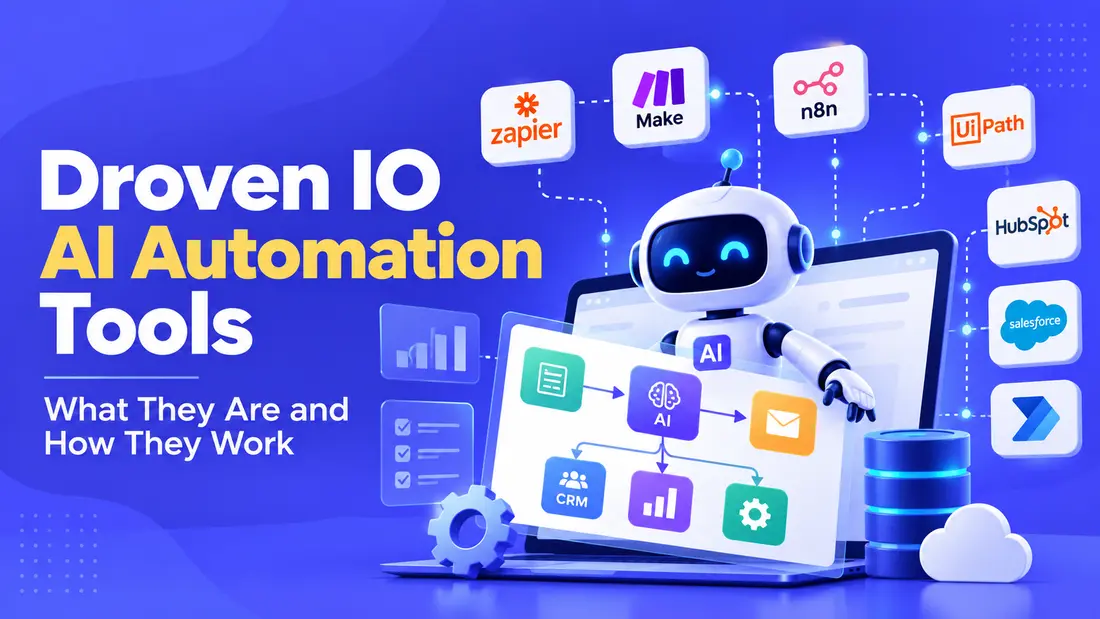
The actual automation work is handled by third-party platforms such as Zapier, Make, n8n, UiPath, GoHighLevel, HubSpot, and Microsoft Power Automate.
So, if you came here looking for a quick answer, here it is:
Droven.io is not the same thing as an AI automation platform. It is better understood as an information resource around technology and automation, while tools such as Zapier, Make, n8n, and UiPath are the platforms used to build and run automated workflows.
Now let’s look at what this means and how these tools fit into a modern business workflow.
What Is Droven.io?
Droven.io can be viewed as a technology and educational platform that covers different areas of modern technology.
Its subject areas include:
- Artificial intelligence
- Automation
- Workflow software
- Machine learning
- Cloud computing
- Cybersecurity
- Business technology
- Productivity tools
The idea is fairly simple. Instead of asking readers to learn every technical concept from scratch, technology-focused publications can explain tools, trends, and software in language that is easier to follow.
For someone researching AI automation, this can be useful during the early stage of choosing software.
For example, imagine you run a small marketing agency. You have leads coming through a website form, someone manually adds those leads to a CRM, another person sends the first email, and a third person creates a task for follow-up.
You don’t necessarily need more employees to handle those steps.
You may need a better workflow.
That’s where AI automation tools come in.
Is Droven.io an AI Automation Software?
No, not in the same sense as Zapier, Make, n8n, or UiPath.
Droven.io is better viewed as a technology content platform rather than software that businesses install and use to automate their internal processes.
This difference matters because the phrase “Droven IO AI Automation Tools” can make it sound like Droven.io is one specific automation product.
It isn’t.
Instead, the phrase connects Droven.io with the broader world of AI automation software.
If you want to actually build an automated workflow, you would normally look at dedicated platforms such as:
- Zapier
- Make
- n8n
- UiPath
- Microsoft Power Automate
- GoHighLevel
- HubSpot
- Salesforce
Each one has a different purpose, pricing model, interface, and level of technical difficulty.
What Does “Droven IO AI Automation Tools” Mean?
Let’s break the search phrase into two parts.
Droven.io refers to the technology website.
AI automation tools refers to software that uses automation, artificial intelligence, integrations, or a combination of these technologies to complete business tasks.
Put them together and the phrase generally points toward information about AI-powered automation tools and the software used to automate business workflows.
This is also why search intent matters.
Someone searching this phrase may want to know:
- What is Droven.io?
- Is Droven.io an automation platform?
- Which AI automation tools are worth using?
- How does AI automation work?
- Which tools are suitable for a small business?
- What can be automated?
- Which platform is best for a particular workflow?
A useful article should answer those questions without making the reader work too hard to find the basic answer.
What Are AI Automation Tools?
AI automation tools are software platforms that help businesses reduce manual work by connecting applications, processing information, making decisions, or triggering actions automatically.
Traditional automation usually follows fixed rules.
For example:
When a customer fills out a form, send an email.
AI automation can add another layer.
For example:
When a customer fills out a form, read the message, identify the customer’s needs, assign a lead score, add the contact to the CRM, and create an appropriate follow-up task.
That is where things get interesting.
How AI Automation Works
A basic AI automation workflow often looks like this:
Trigger → AI Processing → Action → Result
Here is a simple example.
A person fills out a contact form.
The automation receives the submission.
An AI system reads the information and decides whether the lead is asking about pricing, support, or a specific service.
The workflow then sends the information to the right place.
The sales team gets a notification.
The CRM record is updated.
A follow-up email can also be created.
What used to require several manual steps can happen within one workflow.
AI Automation vs Traditional Automation
The two are closely related, but they are not exactly the same.
Traditional automation normally follows predefined rules.
For example:
If a new order is received, send a confirmation email.
AI automation can work with information that is less structured.
For example:
Read the customer’s message, understand what they need, categorize the request, and send it to the correct department.
Traditional automation is often predictable and rule-based.
AI automation can handle text, documents, conversations, classifications, summaries, and other tasks where some level of interpretation is needed.
The best business workflows often use both.
Types of AI Automation Tools Related to the Droven.io Topic
AI automation is a broad category. There isn’t one tool that does everything well.
Different platforms solve different problems.
Workflow Automation Tools
This is one of the easiest places to start.
Popular options include:
- Zapier AI
- Make
- n8n
These platforms connect different applications and allow users to create automated workflows.
For example:
Website form → CRM → Email → Slack notification → Follow-up task
Zapier is often a good choice for users who want a straightforward setup.
Make is useful when workflows become more detailed and visual control is important.
n8n is attractive to technical users who want more control over workflows and hosting.
The right option depends on how much control you need and how technical your team is.
AI CRM and Marketing Automation Tools
Businesses that manage a large number of leads and customers often need more than basic app connections.
This is where platforms such as:
- GoHighLevel
- HubSpot
- Salesforce
can become useful.
These systems can combine CRM features with marketing and AI capabilities.
Common tasks include:
- Capturing leads
- Assigning leads
- Sending follow-up emails
- Managing sales pipelines
- Scoring leads
- Creating customer segments
- Tracking sales activity
- Creating reports
For an agency, for example, having lead capture, CRM management, email follow-ups, and appointment workflows in one system can reduce a lot of manual work.
Robotic Process Automation Tools
RPA stands for Robotic Process Automation.
RPA tools are designed to handle repetitive computer tasks that people often perform manually.
Popular examples include:
- UiPath
- Microsoft Power Automate
Think about an employee who spends hours every week moving information from one system to another.
An RPA workflow may be able to handle that process automatically.
Common examples include:
- Data entry
- Invoice processing
- Report creation
- File management
- Data transfer
- Repetitive administrative tasks
RPA is especially useful when companies still depend on older systems that don’t have modern integrations.
Conversational AI and LLM Automation
Another major area is conversational AI.
Businesses can connect AI models with workflows to create systems that can understand and process natural language.
Examples include:
- Customer support chatbots
- Sales assistants
- Internal AI assistants
- Document analysis systems
- Knowledge base assistants
- Automated email processing
Imagine a support team receiving hundreds of customer messages.
Instead of manually reading every message and deciding where it belongs, an AI workflow can classify incoming messages and send them to the correct queue.
A human can then handle the cases that actually need human attention.
Best AI Automation Tools to Know
There is no universal winner because each platform is built for different needs.
| Tool | Best For | Technical Level | Main Strength |
|---|---|---|---|
| Zapier AI | Simple app automation | Beginner | Easy integrations |
| Make | Visual workflows | Intermediate | Flexible workflows |
| n8n | Custom workflows | Intermediate | Greater control |
| GoHighLevel | Agencies | Intermediate | CRM and marketing |
| HubSpot AI | Sales and marketing | Beginner to Intermediate | CRM ecosystem |
| UiPath | Enterprise RPA | Advanced | Large-scale automation |
| Power Automate | Microsoft users | Beginner to Advanced | Microsoft ecosystem |
The easiest way to choose is to start with the task you want to automate rather than the software you want to buy.
That small change in thinking can save you from choosing an expensive tool that solves the wrong problem.
How to Choose the Right AI Automation Tool
Choosing automation software doesn’t have to be complicated.
Start with the workflow.
Start With the Workflow
Write down the task you want to automate.
For example:
New lead → CRM entry → Email → Sales notification → Follow-up
Now ask which parts are repetitive.
Those are your first automation opportunities.
Check App Integrations
Your automation platform needs to work with the software you already use.
Check whether it supports tools such as:
- Google Workspace
- Microsoft 365
- Slack
- CRMs
- Email platforms
- Forms
- Payment systems
- Project management software
A powerful automation platform isn’t very useful if it cannot connect with the apps your business depends on.
Compare Pricing
Automation pricing can vary quite a bit.
You may see:
- Free plans
- Monthly subscriptions
- Per-user pricing
- Task-based pricing
- Usage-based AI charges
- Enterprise plans
Don’t look only at the starting price.
Think about how much automation your business will actually run each month.
Check Technical Requirements
Some tools are designed for beginners.
Others are built for developers and technical teams.
Before choosing a platform, ask:
Who will build and maintain these workflows?
If the answer is a marketing manager with no coding experience, a simple visual automation platform may be a better choice.
If you have developers on your team, a more flexible platform may make sense.
AI Automation Use Cases for Businesses
The best way to understand AI automation is through real examples.
Lead Generation and Sales
Sales teams can automate:
- Lead capture
- Lead qualification
- CRM updates
- Email follow-ups
- Appointment reminders
- Sales notifications
For example, when someone submits a form, an automation can add the person to the CRM and notify the sales representative immediately.
Marketing
Marketing teams can automate:
- Email workflows
- Campaign reporting
- Customer segmentation
- Content workflows
- Lead nurturing
- Social media processes
This gives marketers more time to work on strategy and creative tasks instead of moving information between platforms.
Customer Support
Customer support is another strong use case.
AI workflows can help with:
- FAQ responses
- Ticket classification
- Customer routing
- Email sorting
- Knowledge base searches
- Support summaries
The goal isn’t always to remove people from the process.
Often, the better goal is to let the AI handle simple requests while human agents focus on cases that need judgment or personal attention.
Operations
Operations teams deal with repetitive tasks every day.
Automation can help with:
- Data entry
- Invoice processing
- Report creation
- Notifications
- Internal approvals
- File organization
Even a small workflow can save time when the same task happens hundreds of times.
E-commerce
Online stores can also use automation for:
- Order notifications
- Customer emails
- Inventory updates
- Product data
- Customer support
- Post-purchase follow-ups
A store owner may not notice how much time these small tasks consume until they are automated.
Benefits of AI Automation Tools
When automation is designed properly, it can make everyday work easier.
Less Repetitive Work
Employees don’t have to spend as much time copying data, sending routine emails, or moving information between systems.
Faster Workflows
An automated workflow can often complete a task immediately after its trigger occurs.
Better Data Handling
When information moves between systems automatically, there are fewer opportunities for manual copying mistakes.
More Consistent Processes
A properly configured workflow follows the same steps each time.
Easier App Integration
Businesses can connect tools that would otherwise operate separately.
Faster Customer Response
Automated notifications, routing, and simple AI responses can help teams respond sooner.
Limitations and Risks of AI Automation
Automation isn’t magic.
It can create new problems if the workflow is poorly designed.
Incorrect AI Outputs
AI can misunderstand information or produce an incorrect response.
For important business decisions, human review may still be necessary.
Integration Problems
Two platforms may not work together perfectly.
APIs, permissions, data formats, and usage limits can all create problems.
Data Privacy
Businesses should understand where customer and company data goes.
Before connecting sensitive information to an AI service, check its data policies, access controls, and security features.
Automation Errors
A workflow can fail because of a missing field, API error, expired connection, or unexpected input.
That is why testing matters.
Ongoing Costs
Automation software can become expensive as usage grows.
AI features may also have separate usage costs.
Always estimate the expected monthly usage before moving a large process into an automated system.
Is Droven.io the Same as Zapier, Make, or n8n?
No.
They serve different purposes.
| Platform | What It Is | Main Purpose |
|---|---|---|
| Droven.io | Technology content platform | Learning and information |
| Zapier | Automation software | App integrations |
| Make | Workflow automation platform | Visual workflows |
| n8n | Workflow automation platform | Flexible workflows |
| UiPath | RPA platform | Business process automation |
This is the key distinction to remember.
Droven.io is associated with information about technology and automation, while platforms such as Zapier, Make, n8n, and UiPath are actual tools used to create automated processes.
If your goal is to automate a business process, you need an automation platform.
If your goal is to learn about AI, automation, and technology, a technology publication can help you understand the options.
How to Get Started With AI Automation
You don’t need to automate your entire company on day one.
Start small.
Step 1: Pick One Repetitive Task
Choose something your team does regularly.
For example, adding new leads to a CRM.
Step 2: Map the Current Workflow
Write down every step.
Don’t skip the small ones.
Step 3: Choose the Right Tool
Look for a platform that supports your apps and workflow.
Step 4: Connect Your Apps
Set up the required integrations and permissions.
Step 5: Build a Small Workflow
Keep the first version simple.
A five-step workflow is easier to test than a 30-step system.
Step 6: Test Every Step
Use sample data before allowing real customers or transactions to pass through the workflow.
Step 7: Monitor Results
Check whether the automation is actually saving time and reducing errors.
Step 8: Expand Gradually
Once the first workflow works reliably, automate the next repetitive process.
This approach is much safer than trying to automate everything at once.
Frequently Asked Questions About Droven IO AI Automation Tools
What is Droven IO AI Automation Tools?
The phrase refers to the topic of Droven.io and AI-powered automation software. Droven.io is associated with technology content, while actual automation is handled by dedicated third-party platforms.
Is Droven.io an AI automation platform?
No. It is better understood as a technology information and education platform rather than software used to build and run business workflows.
What AI automation tools are associated with this topic?
Tools commonly discussed in the AI automation space include Zapier, Make, n8n, GoHighLevel, HubSpot, UiPath, and Microsoft Power Automate.
Is Droven.io free to use?
As an information website, readers can access its published content. This is different from paid automation software, where pricing usually depends on features, users, tasks, or usage.
Can Droven.io automate business workflows?
Droven.io itself should not be treated as a workflow automation engine. Businesses looking to automate processes should use a dedicated automation platform.
What are the best AI automation tools for small businesses?
Zapier and Make can be good starting points for simple workflows. n8n may suit businesses that need more control, while platforms such as GoHighLevel and HubSpot can be useful for sales and marketing operations.
Is Zapier better than Make for AI automation?
It depends on the workflow. Zapier is often easier for beginners, while Make can provide more visual control for workflows with several steps.
Is n8n good for advanced automation?
Yes. n8n is popular with users who want greater control over workflow design and technical setup.
What is the difference between AI automation and RPA?
AI automation can work with information such as text, documents, and natural language. RPA mainly focuses on automating repetitive computer-based actions. Modern business systems can use both approaches together.
Final Verdict
The phrase “Droven IO AI Automation Tools” can be confusing because it sounds like the name of one specific software product.
The simpler way to understand it is this:
Droven.io is an information platform connected with technology topics, while AI automation tools are the actual software platforms businesses use to automate workflows.
If you’re researching automation, don’t start by asking which tool is the most powerful.
Start with a better question:
What task do I want to stop doing manually?
Once you know the answer, finding the right automation platform becomes much easier.
For a simple app-to-app workflow, Zapier may be enough. For more visual and flexible workflows, Make can be a better fit. Technical teams may prefer n8n, while larger companies may look at platforms such as UiPath, Power Automate, Salesforce, or HubSpot.
The best automation setup isn’t the one with the most features.
It’s the one that solves your actual workflow without creating another system your team has to manage.
Read Also: Playing Games Blog PlayBattleSquare: What Is It and How Does It Work?